


Monthly wireline or wireless phone bills can be confusing, which may be one reason the FCC receives tens of thousands of billing complaints each year. To avoid surprises, learn to read your bill, understand your rights and know what to do if you find a problem.
For more information, click the tabs below.
Cramming
Cramming is the illegal act of placing unauthorized charges on your wireline, wireless, or bundled services telephone bill. The FCC has estimated that cramming has harmed tens of millions of American households.
Deception is the hallmark of cramming. Crammers often rely on confusing telephone bills to trick consumers into paying for services they did not authorize or receive, or that cost more than the consumer was led to believe.
Wireless consumers should be particularly vigilant. Smartphones are sophisticated handheld devices that enable consumers to shop online from wherever they are or charge app purchases to their phone bills. The more your mobile phone bill begins to resemble a credit card bill, the more difficult it may become to spot unauthorized charges.
FAQs on Phone Bill Cramming
How does cramming occur?
Cramming most often occurs when telephone companies allow other providers of goods or services to place charges on their customers' telephone bills, enabling a telephone number to be used like a credit or debit card account number for vendors. Crammers may attempt to place a charge on a consumer's phone bill having nothing other than an active telephone number, which can be obtained from a telephone directory.
What do cramming charges look like?
Cramming comes in many forms. Charges may be legitimate if authorized, but are cramming if not. Look for:
- Charges for services that are explained on your telephone bill in general terms such as "service fee," "service charge," "other fees," "voicemail," "mail server," "calling plan" and "membership."
- Charges that are added to your telephone bill every month without a clear explanation of the services provided – such as a "monthly fee" or "minimum monthly usage fee."
- Charges for specific services or products you may not have authorized, like ringtones, cell phone wallpaper, or "premium" text messages about sports scores, celebrity gossip, flirting tips or daily horoscopes.
How can I protect myself against cramming?
- Carefully review your telephone bill every month, just as closely as you review your monthly credit card and bank statements.
- Ask yourself the following questions as you review your telephone bill:
- Do I recognize the names of all the companies listed on my bill?
- What services were provided by the listed companies?
- Does my bill include charges for calls I did not place or services I did not authorize?
- Are the rates and line items consistent with the rates and line items that the company quoted to me?
- When in doubt, ask questions. You may be billed for a call you placed or a service you used, but the description listed on your telephone bill for the call or service may be unclear. If you don't know what was provided for a charge listed on your bill, ask your telephone company to explain it before paying it.
- Make sure you know what service was provided, even for small charges. Cramming often goes undetected as very small "mystery charges" – sometimes only $1, $2, or $3 – to thousands of consumers. Crammed charges can remain on bills for years.
- Keep a record of the services you have authorized and used. These records can be helpful when billing descriptions are unclear.
- Carefully read all forms and promotional materials – including the fine print – before signing up for telephone or other services to be billed on your phone bill.
What should I do if I think I've been crammed?
Take the following actions if your telephone bill lists unknown or suspicious charges:
- Call the phone company responsible for your bill, explain your concerns about the charges, and ask to have incorrect charges removed.
- You can also call the company that charged you, ask them to explain the charges, and request an adjustment to your bill for any incorrect charges.
- If neither the telephone company sending you the bill nor the company that provided the service in question will remove charges you consider to be incorrect, you can file a complaint:
- With the FCC about any charges on your telephone bill, whether they relate specifically to telephone service or to other products or services that appear on your bill;
- With your state public service commission for telephone services within your state; or
- With the Federal Trade Commission about charges for non-telephone services on your telephone bill.
Does my complaint help fight cramming?
Yes. In 2014 and 2015, the FCC, along with other federal and state regulators, took enforcement action against the nation's four largest wireless companies for billing customers millions of dollars in unauthorized third-party premium text messaging services. These cramming cases resulted in a total of $353 million in penalties and restitution.
More recently, in 2019, a carrier agreed to a $550,000 settlement and compliance plan resolving a cramming investigation, and the FCC fined a carrier $2.32 million for slamming and cramming that targeted small businesses.
FCC Action
Know Your Rights
Truth in Billing
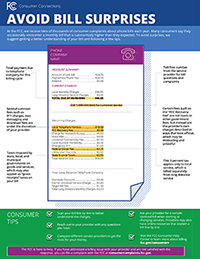
FCC Truth in Billing rules require telephone service providers to:
- Provide clear, factual, plain language descriptions of services for which you are being billed.
- Identify the service provider associated with each charge.
- Specify which charges could result in disconnection of basic local service if they are not paid on time, and which ones would not.
- Display on each bill one or more toll-free numbers that you can call to ask about or dispute any charge.
In addition, wireline telephone companies must:
- Inform consumers of any blocking options offered for third-party billing.
- Place third-party charges in a distinct section of the bill separate from carrier charges.
- Include a separate subtotal for the third-party charges in the distinct bill section and on the payment page.
What you can do
If there are charges on your bill that you believe are incorrect, contact the billing company or the service provider. If you are not satisfied with the response, you can file a complaint with:
- The FCC for charges related to telephone services between states or internationally.
- Your state public service commission for telephone services within your state. Check the blue pages or government section of your local telephone directory for information.
- The Federal Trade Commission for non-telephone services on your telephone bill.
Typical Charges
Understanding Typical Charges on Phone Bills
These are some of the charges you may see on both your wireline and wireless telephone bills:
"Access charges"
- Local telephone companies are allowed to bill customers for a portion of what it costs to provide access to their local networks. These charges are not a government charge or tax. The maximum allowable access charges per telephone line are set by the FCC, but local telephone companies are free to charge less, or even nothing at all.
- Access charges for additional lines at the same residence may be higher than charges for the primary line. These charges may be described on your bill as "Federal Access Charge," "Customer or Subscriber Line Charge," "Interstate Access Charge," or the like.
- State public service commissions regulate access charges for intrastate (within a state) calls. In some states, a state subscriber line charge may appear on customer bills.
"Federal excise tax"
- This 3 percent tax applies only to local service billed separately from long distance service.
"State and local taxes"
- Taxes may be imposed by state, local, and municipal governments on goods and services, including phone service. These may appear as "gross receipts" taxes on your bill.
"Universal service charges"
- All telecommunications service providers must contribute to the federal Universal Service Fund, which helps people in rural and high-cost areas, and income-eligible consumers, get access to telecommunications services at reasonable rates through programs and initiatives such as the Connect America Fund, Lifeline and the E-rate program for schools and libraries.
- A "Universal Service" line item may appear on your telephone bill when your service provider chooses to recover USF contributions from you, the customer. The FCC does not require this charge to be passed on to you, but service providers are allowed to do so. These charges usually appear as a percentage of your phone bill. Companies cannot collect an amount that exceeds the percentage of their own contributions to the USF. They also cannot collect any fees on services fully supported by the Lifeline program.
"911, LNP, and TRS charges"
- 911 – To help local governments pay for emergency services such as fire and rescue.
- Local Number Portability – For keeping your current local telephone numbers when switching from one service provider to another at the same location. Fees may vary by company; some may not charge any fees. These fees are not taxes.
- Telecommunications Relay Service – To help pay for relay services that transmit and translate calls for people with hearing or speech disabilities.
Other charges
- "Directory Assistance" – For placing 411 or (area code) 555-1212 directory assistance calls.
- "Monthly Calling Plan Charge" – For any monthly calling plan, such as unlimited long distance calling on your wireline bill or unlimited minutes on your wireless bill.
- "Operator Assisted Calls" – For calls connected by an operator. Rates for these calls generally are higher than rates for unassisted calls.
- "Features Charges" – For services such as call forwarding, three-way calling, call waiting, voice mail and caller ID.
These charges would appear only on your wireline telephone bill:
- "Minimum Monthly Charge" – Some long distance companies charge a minimum monthly fee even if you don't make long distance calls.
- "Single Bill Fee" – For combining local and long distance charges onto one bill. This fee is not mandated by the FCC and is not an FCC charge. Some companies waive the fee for customers who pay bills online or by credit card. You can avoid the charge by arranging for separate billing from your long distance telephone company.
Finally, these charges would appear only on your wireless telephone bill:
- "Airtime charges" – If you don't have any more voice minutes in your package, you could see airtime or per-minute charges on your wireless bill for any additional voice calls. Some providers round fractions of minutes to the next highest one, two, or three minutes. Check the terms of your service plan.
- "Roaming charges" - Wireless providers typically charge higher per-minute rates for calls made or received outside of the service area or network defined in your service plan or contract. Additional charges, such as a daily access fee, may also be applied.
- "911 charges" - Enhanced 911 service enables wireless telephones used to dial 911 to automatically transmit the caller's location to emergency responders. Wireless service providers may choose to bill their customers for E911 service costs.
- "Text messaging" - You can be charged either a per-message fee or a flat, monthly fee for unlimited messaging.
- "Downloading fees" - For downloading more data (including apps, system upgrades, music files and ring tones) than the plan allows.
- "Detailed billing" - Fees for detailing billing information for calls, such as date, time, duration, number called, or calling party.
Billing in languages other than English
Check with your service provider to see if they provide bills in your preferred language.
Mobile Bill Shock
Tips for Avoiding Mobile Phone Bill Shock
Unexpected overage charges and fees on your mobile phone bill can come as a shock, especially when they result from usage you thought was covered by your plan. To avoid bill shock, following these tips should help.
Think about your typical phone calling use
When setting up your plan options, ask yourself:
- Will I use the phone frequently or for emergencies only?
- Do I call at all times or mainly days, evenings or weekends?
- Are most of my calls local? Regional? Nationwide? Worldwide?
- Are most of my calls to a small number of friends and family, or do I call many different people?
Understand your plan options for data and text
- If you have used data and text plans before – enough to know your usage pattern – talk to your service provider about the plan that will be best for you.
- If you're new to data and text, choose a plan that seems right and monitor your usage during the first few weeks to see if you are approaching your limit.
- If your data or text usage is high, consider an unlimited data plan option.
Ask your carrier how you can avoid bill shock
Options may include phone or text alerts, allowing you to monitor your account online or by giving you additional information.
Consider a pre-paid plan
A pre-paid plan may help keep your phone bill in check. When you "pre-pay" for all your minutes, you will be unable to go over your set limit.
Understand where you may incur roaming fees
- Set up your phone's screen to alert you when you are roaming.
- Ask your service provider where network roaming is likely to occur.
Plan before traveling internationally
If you expect to take your phone outside the United States and use it for voice or data, including email, make sure to find out beforehand what charges your provider may apply.
See our consumer guide on International Roaming: Using Your Mobile Phone in Other Countries.
Bundled Services
Bundled Services and Billing
Combining several communications services — such as local and long distance telephone service, internet or broadband, TV and cable service, and wireless telephone service or Voice over Internet Protocol — into one package is commonly known as bundling. Choosing to bundle, with a single bill for multiple services, may save you money. However, it can also lead to confusion over billing.
For all billing or service issues, you should first try to resolve the issue directly with your service provider.
What should I do if I have a problem with my local telephone service?
If you have a problem with local service, including directory assistance or telephone service within your state, contact your state public service commission. Contact information can be found in the blue pages or government section of your local telephone directory.
What should I do if I have an issue with basic cable TV service rates or cable TV service quality?
Contact your cable local franchising authority. Contact information can be found on your cable service bill or in your local telephone directory. Other resources include:
- Your state or local Better Business Bureau
- Your state or local consumer protection agency
- Your state attorney general's office
What about satellite service issues?
The FCC does not regulate the cost charged for satellite programming, nor does it control how such programming is sold or packaged. The terms of the contract entered into by the customer and the satellite company determine the rights and obligations of each party. State consumer laws may apply to these agreements. Contact your state department of consumer affairs for more information.
Printable Version
Understanding Your Telephone Bill (PDF)
Alternate Format Requests
People with print disabilities may request braille, large print, or screen-reader friendly versions of this article via the email form at fcc504@fcc.gov. For audio and other access, use the "Explore Accessibility Options" link.
Consumer Help Center
Learn about consumer issues - visit the FCC's Consumer Help Center at fcc.gov/consumers
File a Complaint with the FCC
Visit our Consumer Complaint Center at consumercomplaints.fcc.gov to file a complaint or tell us your story.